7.手性醇的合成
在药物合成中,醇是一种重要中间体。由于手性的药物越来越多,手性醇的合成近年来越来越受到重视。最常用的方法有:不对称酮还原为手性的仲醇、Sharpless不对称双羟化、Sharpless不对称羟胺化、通过不对称环氧化引入手性和从手性a-氨基酸合成手性a-羟基酸等。
7.1不对称酮还原为手性的仲醇
不对称酮还原为手性的仲醇的方法常用的有:CBS还原法、不对称氢化和YEAST还原法等。
7.1.1 CBS还原法
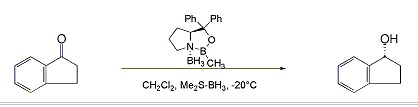
Prodedure:
(R)-2,3-Dihydro-1H-inden-1-ol. A 250-mL, three-necked, round-bottomed flaskis equipped with a Teflon-coated thermocouple probe, a 125-mL pressure-equalizing addition funnel, nitrogen inlet, and Teflon-coated magnetic stirring bar. The flask is charged with the (S)-oxazaborolidine-borane complex (2.91 g, 10.0 mmol), purged with nitrogen, and charged with dry dichloromethane (10 mL). To the stirred solution is added borane-methyl sulfide (10 M, 20 mL, 200 mmol). The solution is cooled to −20°C and the addition funnel charged with a solution of 1-indanone (26.4 g, 200 mmol) in dry dichloromethane (75 mL). The 1-indanone solution is then added dropwise over a 4–6 hr period while maintaining the internal temperature of the reaction mixture at −20±5°C. After the addition is complete, the reaction mixture is stirred for 2 hr at −20°C. After the reaction is complete, the mixture is cautiously poured into a 1-L flask containing magnetically-stirred, pre-cooled (−20°C) methanol (300 mL). The cooling bath is removed, and the stirred mixture allowed to warm to room temperature (20–25°C). After evolution of hydrogen ceases, the mixture is concentrated by distillation (1 atm) to a volume of ca. 50 mL. Methanol (200 mL) is added, and the distillation repeated.The residue containing the product and diphenylprolinol is diluted with methanol (100 mL) and then loaded onto a 2.5 × 30-cm column packed with Amberlyst 15 (NH+4) at ca. 2.5 mL/min, collecting 40-mL fractions. The column is rinsed with methanol until the product is eluted. The column is then rinsed with 1 M methanolic ammonia until the diphenylprolinol is eluted. The fractions containing the product (2–15) are combined, and then concentrated under reduced pressure (40°C, 100 mm) to give 26.2 g of crude product as a white crystalline solid. The crude product is dissolved in hexane (260 mL) at 50–60°C in a 500-mL, round-bottomed flask fitted with a mechanical stirrer. The product is allowed to crystallize as the stirred mixture is slowly cooled to 20–25°C. The mixture is stirred for 4 hr at 20–22°C, filtered, and the cake washed with hexane (2 × 25 mL). The product is dried in a vacuum oven (30°C, 10 mm) to constant weight to yield 24.1–25.2 g (90–94%) of the title compound as a white crystalline solid.
7.1.2 不对称氢化 :

A. Preparation of catalyst solution. A 250-mL, round-bottomed flask fitted with a septum and magnetic stirring bar is charged with 486.9–488.2 mg (0.985–0.990 × 10⁻³mol) of chloro(1,5-cyclooctadiene)rhodium(I) dimer and, under argon, with 1.20 g (2.15 × 10⁻³ml) of (2S,4S)-N-tert-butyloxycarbonyl-4-diphenylphosphino-2-diphenylphosphinomethylpyrrolidine, (S,S)-BPPM. The sealed flask is charged by cannula, under argon, with 150 mL of degassed benzene and stirred under argon for 15 min at room temperature. The catalyst is transferred by cannula, under argon, into the autoclave (see below).
B.Asymmetric hydrogenation. A stainless steel stirred autoclave with a total volume of 500 mL is charged with 25.6 g (0.2 mol) of ketopantoyl lactone. The autoclave is flushed with argon and the catalyst solution (see above) is added by cannula, under argon. The autoclave is sealed and hydrogenation is carried out at 40°C, 750-psig hydrogen and 950–1050 rpm for 48 hr. Care should be taken to flush all the lines before connecting to the autoclave. After the autoclave is cooled to room temperature, it is vented and opened. The reaction mixture is then transferred to a 500-mL, round-bottomed flask and most of the solvent is removed by rotary evaporator. Distillation of this reddish solid affords 24–25.6 g (92–98%) of D-(−)-pantoyl lactone: bp 90–110°C (4 cm); [α]D25−39.3℃to −42.4℃(c2, H2O) (78 to 84% e.e.) and.The pantoyl lactone thus obtained (25.41 g), [α]D25−40.8°(80.5% e.e.) is refluxed with 75 mL benzene and 290 mL of UV-grade hexanes. The cloudy solution is stirred briskly overnight as solids form. Filtration of the solids and drying for 3 hr at 0.25 mm, 30°C in a vacuum oven affords 21.51 g of product; [α]D25−47.7°(94.27% e.e.). This material is again refluxed and crystallized from 30 mL of benzene and 116 mL of UV-grade hexanes to afford 19.97 g (77%) of product; [α]D25−49.87°(98.5% e.e.). Anal. calcd. for C6H10O3: C, 55.37; H, 7.75. Found: C, 55.34; H, 7.57.
7.1. 3 Yeast Reduction o f Ethyl Acetoacetate : ( S )-( + )-Ethyl 3-Hydroxybutanoate

A 4-L, three-necked, round-bottomed flask equipped with mechanical stirrer, bubble counter, and a stopper is charged with 1.6 L of tap water, 300 g of sucrose, and 200 g of baker's yeast, which are added with stirring in this order. The mixture is stirred for 1 hr at about 30°C, 20.0 g (0.154 mol) of ethyl acetoacetate is added, and the fermenting suspension is stirred for another 24 hr at room temperature. A warm (ca. 40°C) solution of 200 g of sucrose in 1 L of tap water is then added, followed 1 hr later by an additional 20.0 g (0.154 mol) of ethyl acetoacetate. Stirring is continued for 50–60 hr at room temperature. When the reaction is complete by gas chromatographic analysis, the mixture is worked up by first adding 80 g of Celite and filtering through a sintered-glass funnel (porosity 4, 17-cm diam). After the filtrate is washed with 200 mL of water, it is saturated with sodium chloride and extracted with five 500-mL portions of ethyl ether. The combined ether extracts are dried over magnesium sulfate, filtered, and concentrated with a rotary evaporator at 35°C bath temperature to a volume of 50–80 mL. This residue is fractionally distilled at a pressure of 12 mm through a 10-cm Vigreux column, and the fraction boiling at 71–73°C (12 mm) is collected to give 24–31 g (59–76%) of (S)-( + )-ethyl 3-hydroxybutanoate; the specific rotation [α]25D + 37.2° (chloroform,c1.3) corresponds to an enantiomeric excess of 85%.
The enantiomeric excess may be enhanced by several crystallizations of the 3,5-dinitrobenzoate derivative or else by using "starved" yeast.
7.2 Sharpless不对称双羟化
由于四氧化锇或者高锰酸钾都可以从烯烃的平面的任意一侧与烯烃形成环状酯,所以得到的顺式羟基化产物必为两种对映体的混合物,这两种氧化剂都没有高对映选择性,所以发现和寻求具有高对映选择性的氧化催化剂,是研究者追求的目标。这样的探索始于20世纪初,直到20世纪90年代初才获得较好的结果。这一领域的先锋是Sharpless小组,他们和其他小组一样主要在寻找最有效的四氧化锇与手性配体的配合物。并且认为受性配体是手性生物碱配体与四氧化锇结合得越牢,越稳定,则产物的%ee值就越高。
发现这一类型手性配体的轨迹始于手性吡啶与四氧化锇所形成配合物,用此作为催化剂,所得到的邻二醇仅有很低的对应体纯度(3%-18% ee),原因在于四氧化锇和手性吡啶配和物不稳定。但是这是一个很好的提示,Sharpless等人选择天然的金鸡纳生物碱,即奎宁和奎尼定(衍生为二氢奎宁和二氢奎尼定酯类)作手性配体,结果四氧化锇与奎宁环上的桥头手性氮原子有很强的结合,使邻二醇有了教高的对映体过量(可达到>80% ee),而且将反应的速度提高了1-2数量级。
7.2.1 Sharpless不对称双羟化示例

A mixture of 2-[4-(benzyloxycarbonyl)piperazin-1-yl]-4-[trans-(2-buten-1-yl)oxy]quinazoline (1.30 g), a solution of osmium tetroxide in t-butanol (osmium tetroxide 106 mg/t-butanol 8.36 g) (312 mg) and 4-methylmorpholine N-oxide (382 mg) acetone is distilled off from the reaction mixture under reduced pressure, and the resultant product is diluted with ethyl acetate, and the mixture is washed with 10percent aqueous sodium sulfite solution and water. in water (2 ml)--acetone (15 ml) is stirred at room temperature for 14 hours.. The ethyl acetate solution is dried over anhydrous magnesium sulfate and evaporated to dryness under reduced pressure, and the residue is purified by medium pressure liquid column chromatography (eluent, chloroform:methanol=100:1, v/v) to give 2-[4-(benzyloxycarbonyl)piperazin-1-yl]-4-[(2RS,3RS)-(2,3-dihydroxybutan-1-yl)oxy]quinazoline (1.02 g) as foam. NMR (300 MHz, CDCl3--D2O, dppm): 1.32 (3H, d, J=6 Hz), 3.60 (4H, m), 3.8-4.0 (6H, m), 4.54 (1H, dd, J=6, 11.5 Hz), 4.63 (1H, dd, J=4, 11.5 Hz), 5.17 (2H, s), 7.16 (1H, ddd, J=1, 7, 8 Hz), 7.3-7.4 (5H, m), 7.51 (1H, dt, J=1, 8.5 Hz), 7.62 (1H, ddd, J=1.5, 7, 8.5 Hz), 7.89 (1H, dd, J=1.5, 8 Hz).
🔙返回上一页🔙